
+92306 3026 466
SEO vs AEO vs GEO: What’s the Future of Search in 2026?
Summarize this post
What Is the Difference Between SEO, AEO, and GEO?
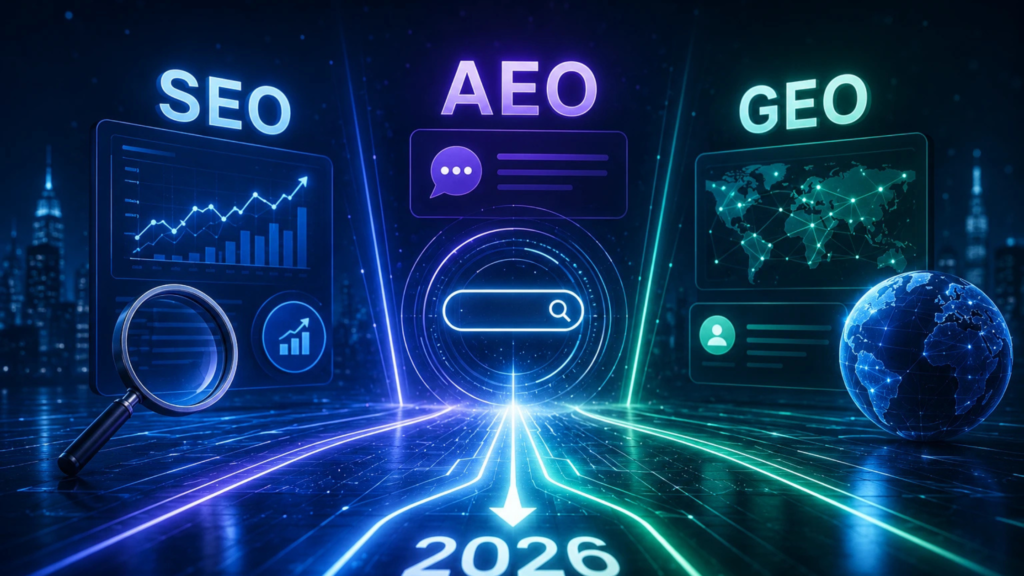
SEO (Search Engine Optimization) is the practice of ranking your website in traditional Google search results. AEO (Answer Engine Optimization) is optimizing your content to be selected as the direct answer by AI assistants like ChatGPT, Perplexity, and Gemini. GEO (Generative Engine Optimization) is optimizing your content to appear inside Google’s AI-generated search summaries, AI Overviews. In 2026, all three matter. SEO is still the foundation, but AEO and GEO are rapidly becoming essential as AI changes how people search and how search engines respond.
Introduction
Search is changing faster right now than at any point in the last decade.
For years, SEO meant one thing: rank on Google’s blue links. Get to page one, get the traffic. The rules were clear, the tools were established, and the playbook keyword research, on-page optimization, backlinks was well understood.
Then AI arrived and rewrote the rules.
Google’s AI Overviews now answer millions of queries before users ever see a traditional search result. ChatGPT, Perplexity, and Gemini have become search engines in their own right with hundreds of millions of users asking them questions and acting on the answers they receive. Zero-click searches have reached record highs as AI generates direct answers that remove the need to visit any website at all.
For businesses and content creators, this shift raises an urgent question: if the future of search is AI-generated answers, what happens to SEO? And what are AEO and GEO, the two new disciplines emerging to fill the gaps traditional SEO cannot?
At Codefyze, we have been studying this shift closely. In this guide, we break down all three disciplines, SEO, AEO, and GEO, what each one is, how they differ, where they overlap, and what you actually need to do to maintain and grow your visibility as search evolves.
Part 1: SEO The Foundation That Still Matters
What Is SEO (Search Engine Optimization)?
Search Engine Optimization is the practice of improving a website’s visibility in traditional search engine results pages primarily Google, which holds over 90% of global search market share. SEO involves optimizing content, technical site structure, and off-page authority to rank higher for specific keywords that your target audience searches for.
SEO has been the dominant digital marketing discipline for over two decades and remains the highest-ROI channel for most businesses. When done well, SEO produces compounding organic traffic that does not require ongoing ad spend to maintain.
Core Pillars of Traditional SEO:
• On-page SEO: Optimizing title tags, meta descriptions, headings, content, and URL structure for target keywords.
• Technical SEO: Ensuring Google can crawl, render, and index your site correctly covering site speed, mobile-friendliness, Core Web Vitals, and structured data.
• Content SEO: Creating comprehensive, high-quality content that matches search intent and demonstrates expertise on a topic.
• Off-page SEO: Building backlinks from authoritative websites to signal credibility and relevance to Google.
• Local SEO: Optimizing for location-based searches through Google Business Profile and local citations.
Is Traditional SEO Dead in 2026?
No, and anyone telling you otherwise is wrong. SEO is not dead. It is evolving.
Google still processes over 8.5 billion searches per day. The majority of those searches still result in clicks to websites. Businesses that rank on page one of Google still capture the majority of organic traffic for their target keywords. The fundamentals of SEO quality content, technical health, authority signals are still the foundation of search visibility.
What has changed is that SEO alone is no longer sufficient. The rise of AI-powered search has added two new layers of visibility AEO and GEO that businesses need to understand and optimize for in addition to traditional SEO.
Part 2: AEO Optimizing for AI Assistants
What Is AEO (Answer Engine Optimization)?
Answer Engine Optimization is the practice of optimizing your content to be selected and cited by AI-powered answer engine platforms like ChatGPT, Perplexity AI, Google Gemini, Microsoft Copilot, and voice assistants like Siri and Alexa.
Unlike traditional search engines that return a list of links, answer engines synthesize information from multiple sources and deliver a single, direct answer. The difference is profound: in traditional search, your goal is to rank in the top ten results. In answer engine optimization, your goal is to be the source the AI chooses when it constructs its answer.
In traditional SEO, you compete for a position. In AEO, you compete to be the source.
Why AEO Is Growing Rapidly in 2026:
• ChatGPT reached 100 million users faster than any platform in history and continues to grow millions of people now use it as their primary research tool.
• Perplexity AI has emerged as a serious search alternative, processing millions of queries daily with direct, cited answers.
• Google Gemini is integrated into Google’s own products and used by hundreds of millions of people for AI-assisted answers.
• Voice search powered by Siri, Alexa, and Google Assistant delivers single spoken answers to queries, with no list of results to scroll through.
• Younger users increasingly turn to AI tools first for research, product recommendations, and information before or instead of traditional Google search.
How AI Answer Engines Choose Their Sources:
Understanding how AI assistants select which sources to cite is the core of AEO strategy. While the exact algorithms vary by platform, the consistent factors across ChatGPT, Perplexity, and Gemini are:
• Authority and credibility: AI models are trained on and continue to retrieve from sources that demonstrate expertise, authority, and trustworthiness the same EEAT signals Google’s search algorithm values.
• Clear, direct answers: Content that answers a question directly and concisely in its early paragraphs is more likely to be extracted as the basis for an AI answer than content that buries its main point.
• Structured content: Well-organized content with clear headings, bullet points, and logical structure is easier for AI to parse and extract relevant information from.
• Schema markup and structured data: FAQ schema, How To schema, and Article schema help AI systems understand what type of content a page contains and what questions it answers.
• Factual accuracy and recency: AI systems prioritize information that is accurate, specific, and current vague or outdated content is less likely to be selected.
• Brand mentions across the web: The more your brand is mentioned in reputable sources across the web, the more AI models include you in their knowledge about a topic.
AEO Optimization Tactics What to Do:
• Write direct answer paragraphs: Start every blog post and key page with a clear, concise answer to the main question the page addresses within the first two to three sentences. This is the format AI engines extract for direct answers.
• Use FAQ sections: Add FAQ sections to your key pages with clearly worded questions and direct answers. FAQ schema markup makes these even more accessible to AI systems.
• Create definition content: Pages that clearly define terms, concepts, and entities in your industry are frequently cited by AI tools when users ask ‘what is X’ questions.
• Build topical authority: Publish comprehensive content clusters that cover every aspect of your key topics. AI systems favor sources that demonstrate deep, broad expertise in a subject area.
• Get mentioned on authoritative sites: The more your brand appears in reputable publications, industry sites, and high-authority sources, the more AI models associate your brand with expertise in your field.
• Optimize for conversational queries: AI assistants receive natural language questions ‘what is the best way to…’ rather than ‘best [keyword]’. Write content that answers these conversational formats.
Pro Tip: Check what ChatGPT and Perplexity say when you ask them questions in your industry. If competitors are being cited and you are not, study their content structure and apply the same principles to your own content.
Part 3: GEO Optimizing for AI-Generated Search Results
What Is GEO (Generative Engine Optimization)?
Generative Engine Optimization is the practice of optimizing your content to appear in AI-generated search result summaries most prominently Google’s AI Overviews (formerly Search Generative Experience or SGE), but also Bing’s AI-powered search summaries and other generative search interfaces.
GEO is the newest of the three disciplines and directly addresses one of the most significant changes in Google’s history: the introduction of AI-generated answer summaries at the top of search results pages, above all traditional blue links.
How Google AI Overviews Work:
When a user searches for an informational query, Google’s AI Overview generates a summary answer using information from multiple web pages and displays it at the very top of the search results above position one. The AI Overview cites its sources with small links, and users can click through to those sources or simply read the AI-generated answer without visiting any website at all.
This is why GEO has become critical for visibility: if your content is not being cited in AI Overviews for your target queries, you are invisible at the top of the most valuable position in Google search even if you rank number one in traditional results below the AI Overview box.
Zero-Click Searches The Challenge GEO Addresses:
Zero-click searches where the user gets their answer directly from the search results page without clicking any link have been growing for years. Featured snippets, Knowledge Panels, and People Also Ask boxes all contribute to zero-click behavior. AI Overviews accelerate this trend dramatically.
For businesses that depend on organic traffic, this creates a genuine challenge: you might rank number one for a high-volume keyword but receive fewer clicks than before because AI Overviews are answering the query at the top of the page. GEO is about ensuring that when that happens, it is your content being cited and your brand being surfaced, so you maintain visibility even in a zero-click environment.
How Google Selects Sources for AI Overviews:
• Ranking correlation: Pages that rank well in traditional search results are more likely to be cited in AI Overviews giving you another reason to maintain strong traditional SEO.
• Content quality and helpfulness: Google’s Helpful Content system evaluates whether content genuinely serves users pages that pass this evaluation are more likely to be included in AI Overview citations.
• Structured data: Schema markup helps Google’s AI understand the content type and extract specific information more accurately.
• Direct answer format: Content that provides clear, specific answers to questions in well-structured paragraphs is more extractable by Google’s generative AI.
• E-E-A-T signals: Experience, Expertise, Authoritativeness, and Trustworthiness signals author credentials, about pages, citations from reputable sources are evaluated by Google’s AI systems.
• Page speed and Core Web Vitals: Google’s generative AI favors pages that meet technical quality standards slow or technically broken pages are less likely to be cited.
GEO Optimization Tactics What to Do:
• Optimize for AI Overview format: Write content with clear question-and-answer structure. Include the question as a heading (H2 or H3) and follow it immediately with a direct, concise answer in the first one to two sentences.
• Add structured data: Implement FAQ schema, HowTo schema, and Article schema across your content. These markup types directly help Google’s AI understand and extract your content for generative summaries.
• Target informational queries: AI Overviews appear most frequently on informational searches ‘how to’, ‘what is’, ‘why does’, ‘best way to’. Optimize existing content and create new content targeting these query types.
• Maintain strong traditional SEO: The strongest correlation with AI Overview citations is traditional ranking position. Pages that rank in the top five for a query are most likely to be cited in the AI Overview for that query, so traditional SEO and GEO are complementary, not competing.
• Build E-E-A-T signals: Add author bios with credentials, cite your sources, link to authoritative references, and ensure your About page clearly communicates your expertise. These signals influence both traditional rankings and AI Overview citations.
• Monitor your AI Overview appearances: Use Google Search Console to track impressions and clicks. Compare performance on queries where AI Overviews appear versus those where they do not this tells you how GEO is affecting your specific traffic.
Pro Tip: Use Google’s URL Inspection tool to check how Google renders your pages. If Google cannot read your content correctly, due to JavaScript rendering issues or other technical problems it cannot include that content in AI Overviews regardless of quality.
SEO vs AEO vs GEO Side by Side Comparison
Goal:
SEO → Rank in Google’s traditional blue link results
AEO → Be cited by AI assistants (ChatGPT, Perplexity, Gemini)
GEO → Appear in Google’s AI Overview summaries
Primary Platform:
SEO → Google Search (and Bing, DuckDuckGo)
AEO → ChatGPT, Perplexity AI, Google Gemini, voice assistants
GEO → Google AI Overviews, Bing Copilot generative results
Key Ranking Signals:
SEO → Keywords, backlinks, technical health, content quality, E-E-A-T
AEO → Direct answer format, brand authority, structured content, topical expertise
GEO → Traditional ranking position, structured data, helpful content signals, E-E-A-T
Content Format:
SEO → Comprehensive, keyword-optimized, well-structured content
AEO → Direct answers, FAQ format, conversational language, definition content
GEO → Question-answer structure, schema markup, concise extractable paragraphs
Traffic Type:
SEO → Click-through traffic to your website
AEO → Brand mentions and citations in AI responses (often no direct click)
GEO → Citations in AI summaries with source links (partial click-through)
Maturity Level:
SEO → Fully mature, 20+ years of established practice
AEO → Emerging — growing rapidly in 2026
GEO → Very new — evolving as Google’s AI search matures
Where SEO, AEO, and GEO Overlap The Good News
The most important insight for anyone trying to navigate this three-way complexity is this: the fundamentals that make content perform well in traditional SEO are the same fundamentals that make content perform well in AEO and GEO.
High-quality, comprehensive, well-structured, authoritative content wins across all three. The differences are in the specific format optimizations, direct answer paragraphs, schema markup, FAQ structure layered on top of strong foundational SEO.
You do not need three completely separate strategies. You need one strong content and SEO strategy, with additional layers of optimization for AI search formats.
The Overlapping Factors That Matter Across All Three
E-E-A-T (Experience, Expertise, Authoritativeness, Trustworthiness): Build trust through expert authors, reliable sources, consistent content, and industry recognition.
Quality & helpful content: SEO, AEO, and GEO all prioritize accurate, useful, and user-focused content.
Clear content structure: Use proper headings, short sections, and easy-to-scan formatting to help search engines and AI systems understand your content.
Structured data markup: Schema helps improve search visibility, AI understanding, and content extraction.
Topical authority: Create comprehensive content clusters to establish your website as a trusted source on a topic.
Your Practical Search Strategy for 2026: SEO + AEO + GEO Together
Here is how Codefyze recommends approaching search optimization in 2026, covering all three disciplines without spreading your efforts too thin:
Foundation Get Traditional SEO Right First:
• Maintain strong technical SEO fast pages, mobile-friendly, properly indexed, no crawl errors.
• Publish comprehensive, keyword-targeted content that matches search intent.
• Build backlinks from authoritative, relevant sources.
• Establish clear E-E-A-T signals across your site author pages, credentials, cited sources.
Reason: Traditional SEO ranking is still the strongest predictor of both GEO citations (Google AI Overviews favor already-ranking pages) and AEO mentions (AI tools tend to cite well-known, authoritative sources). Get the foundation right and it lifts all three disciplines.
Layer 2. Optimize Content Format for AI Extraction (AEO + GEO):
• Add a direct answer paragraph to the beginning of every blog post and key page, the first two to three sentences should concisely answer the main question.
• Add FAQ sections to key posts and pages with clear question headings and direct answers.
• Implement FAQ schema, Article schema, and HowTo schema across relevant content.
• Write headings as questions where natural ‘What Is AEO?’ not just ‘AEO Overview’.
Reason: These format changes improve both AEO (AI assistants extract direct answers) and GEO (Google’s AI Overviews extract concise, structured information) without hurting traditional SEO performance.
Layer 3. Build Brand Authority Across the Web (AEO):
• Get mentioned in reputable industry publications, podcasts, and roundups.
• Contribute guest content to authoritative sites in your niche.
• Be consistent and present on platforms where your audience asks AI tools for recommendations forums, Reddit, Quora, LinkedIn.
• Monitor and respond to AI tool outputs in your niche, check what ChatGPT and Perplexity say about your industry topics regularly.
Reason: AEO depends heavily on brand authority signals across the web. The more your brand is mentioned in high-quality, relevant contexts, the more AI systems include you in their responses.
Layer 4. Monitor and Adapt:
• Track Google AI Overview appearances using Google Search Console watch for impression changes on informational queries.
• Test your key queries in ChatGPT, Perplexity, and Gemini monthly see if your brand is being cited and what content is being referenced.
• Watch for zero-click trends on your top keywords if clicks are dropping despite stable rankings, AI Overviews may be intercepting traffic.
• The current AEO and GEO are evolving rapidly. What works in early 2026 may need adjustment by the end of the year.
What This Means for Your Business Practically
Not every business needs to invest equally in all three disciplines right now. Here is a practical framework for prioritizing:
If you are a local business:
Traditional local SEO and Google Business Profile optimization remain your highest-priority activities. AI Overviews appear less frequently for local intent searches, and AI assistants are less relevant for ‘near me’ queries. Focus on SEO first, add AEO considerations to your content over time.
If you are a B2B company or SaaS business:
AEO is increasingly important for you. Decision-makers and researchers are using ChatGPT and Perplexity to evaluate vendors, understand solutions, and research markets before ever visiting a website. Being cited as an authoritative source in these tools is becoming a meaningful part of the B2B purchase journey. Invest in thought leadership content, FAQ pages, and brand authority building.
If you are a content publisher or blogger:
GEO is your most urgent challenge. AI Overviews directly intercept traffic for the informational queries that drive most blog traffic. Optimize your content for AI Overview citations, structured answers, schema markup, E-E-A-T signals, so that even when AI Overviews appear, your content is being cited and your brand is visible.
If you are an e-commerce business:
Traditional SEO remains critical for product and category page rankings. AEO matters for product research queries, users asking AI tools for product recommendations. Focus on generating reviews, building brand authority, and ensuring your products appear correctly in AI-powered shopping research.
How Codefyze Approaches Search in 2026
At Codefyze, we have built our entire content and SEO strategy around the reality that search is no longer one channel, it is three overlapping channels that require a unified but layered approach.
Every piece of content we create starts with traditional keyword research and search intent analysis. We then layer in AI-optimized formatting direct answer paragraphs, FAQ sections, structured data. We build topical authority through content clusters that link together and signal comprehensive expertise. And we monitor performance across traditional search, AI Overview citations, and AI assistant mentions.
The businesses that treat SEO, AEO, and GEO as one integrated strategy rather than three separate projects are the ones that will build lasting search visibility as AI continues to reshape how people find information.
If you want help developing a search strategy that covers all three disciplines for your specific business, the Codefyze team is ready to help you figure out the right approach.
Final Thoughts: The Future of Search Is Already Here
SEO, AEO, and GEO are not competing strategies; they are three layers of the same evolving search landscape.
Traditional SEO is not dead, it is the foundation everything else builds on. AEO is the discipline for the growing share of searches happening inside AI assistants rather than traditional search engines. GEO is the discipline for maintaining visibility as Google itself transforms into an AI answer engine.
The businesses that understand all three and build a content strategy that addresses all three simultaneously are the ones that will thrive as search continues to evolve. The ones that optimize only for traditional blue-link rankings risk losing visibility in the channels where their audience increasingly lives.
The future of search is not a single channel. It is a distributed, AI-powered ecosystem where visibility requires both depth and adaptability.
At Codefyze, we are already building that future into every content and SEO strategy we develop. If you want to understand what it means for your specific business, and what you should be doing about it right now, reach out and let us talk.
On this page
Related Topics
< FAQS >
No Confusion. Just Clarity.
Get quick, clear answers to everything you need to know about working with us.
- What is the difference between SEO and AEO?
SEO (Search Engine Optimization) focuses on ranking in traditional search results, while AEO (Answer Engine Optimization) focuses on getting your content cited by AI tools like ChatGPT and Google Gemini. SEO aims for clicks, whereas AEO aims to be the direct answer source.
- What is GEO (Generative Engine Optimization)?
GEO (Generative Engine Optimization) is the process of optimizing content to appear in AI-generated summaries like Google’s AI Overviews. It focuses on getting your content cited as a source, even when users don’t click on websites.
- Is SEO still important in 2026?
Yes, SEO is still essential in 2026 because it drives website traffic and supports both AEO and GEO. High-ranking pages are more likely to be cited in AI answers and summaries, making SEO the foundation of search visibility.
- How do I optimize for Google AI Overviews?
To optimize for AI Overviews, maintain strong SEO rankings, use clear question-based headings, provide direct answers at the start, add schema markup, improve page speed, and ensure mobile-friendly design. Monitor performance in Google Search Console.
- What is a zero-click search?
A zero-click search is when users get answers directly on the search results page without clicking any link, often through snippets or AI summaries. This trend is increasing with AI-powered search features.
- Should I optimize for ChatGPT and Perplexity as well as Google?
Yes, optimizing for platforms like ChatGPT and Perplexity AI helps build early-stage brand visibility, especially for research-driven users. Focus on authoritative and well-structured content.

Related Blog Posts
Competitor Backlink Analysis: How to Find and Replicate Your Competitor’s Best Links
Competitor backlink analysis is the process of studying where your competitors get their backlinks from…

CodeFyze
July 30, 2026
Citation Building vs Backlink Building: What’s the Difference and Why You Need Both
Citation building involves listing your business’s name, address, and phone number (NAP) consistently across online…
CodeFyze
July 29, 2026

HARO/Journalist Outreach: Getting Backlinks from News and Media Sites
HARO link building is the process of earning high-authority backlinks by responding to journalist queries…
CodeFyze
July 29, 2026
Questions? Reach us on Whatsapp +971 55 265 4401 Or Email info@codefyze.com
Questions? Reach us on Whatsapp +44 798 504 1813 Or Email info@codefyze.com
< recent blogs >
Latest Insights & Articles
Explore our latest articles, tips, and insights all in one place.
#BacklinkAnalysis, #CodeFyze, #CompetitorSEO, #DigitalMarketing, #LinkBuilding, #OffPageSEO, #SemrushSEO, #SEOStrategy, #SEOTools
Competitor Backlink Analysis: How to Find and Replicate Your Competitor’s Best Links
Competitor backlink analysis is the process of studying where your competitors get their backlinks from…

CodeFyze
July 30, 2026
#BacklinkBuilding, #CitationBuilding, #CodeFyze, #DigitalMarketing, #GoogleBusinessProfile, #LocalSEO, #NAPCitations, #SEOStrategy
Citation Building vs Backlink Building: What’s the Difference and Why You Need Both
Citation building involves listing your business’s name, address, and phone number (NAP) consistently across online…
CodeFyze
July 29, 2026
#BacklinkStrategy, #CodeFyze, #ContentMarketing, #DigitalPR, #EEAT, #HARO, #JournalistOutreach, #LinkBuilding
HARO/Journalist Outreach: Getting Backlinks from News and Media Sites
HARO link building is the process of earning high-authority backlinks by responding to journalist queries…
CodeFyze
July 29, 2026