+92306 3026 466
Key Factors for Improving Website Visibility in Search Results (Complete Guide)
Summarize this post
How Do You Improve Website Visibility in Search Results?
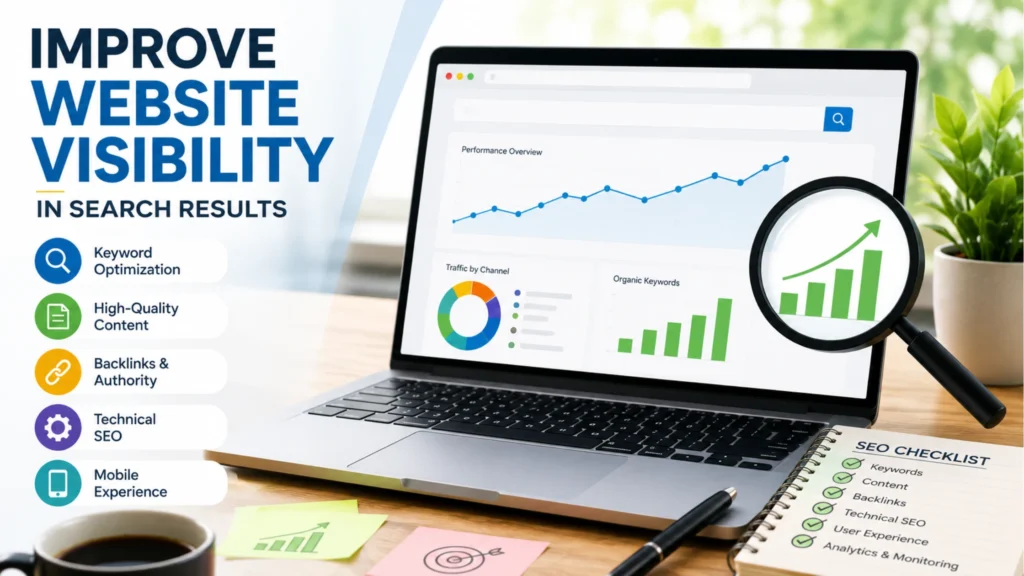
To improve website visibility in search results, you need to work on four core areas: on-page SEO (optimizing your title tags, meta descriptions, headings, and content for target keywords), technical SEO (making sure Google can crawl and index your site correctly), content quality (publishing useful, authoritative content that matches what users are searching for), and off-page authority (earning backlinks from credible websites). Consistently improving these four areas tracked through Google Search Console is how websites climb Google rankings and increase organic traffic over time.
Introduction
If your website is not showing up on Google, it is not really working for your business.
It does not matter how well-designed your site is, how good your product is, or how much you have invested in building it. If customers cannot find you in search results, that investment is not delivering what it should.
Website visibility in search engines is not a mystery, but it is also not simple. It is the result of getting multiple things right at once: your content, your site’s technical health, your credibility in Google’s eyes, and the signals you send about what your pages are actually about.
At CodeFyze, we have helped businesses go from invisible on Google to ranking on page one for competitive terms. In this guide, we break down every key factor that determines your website’s search visibility and exactly what to do about each one.
Why Website Search Visibility Matters More Than Ever in 2026
Over 90% of online experiences begin with a search engine. Google alone processes more than 8.5 billion searches every day. The businesses that appear on page one capture the vast majority of that traffic; the first result alone typically gets 25 to 30% of all clicks for a query.
Page two? It barely gets clicked at all. There is a reason SEO professionals’ joke that the best place to hide something is page two of Google.
In 2026, with AI-generated search results, Google’s Search Generative Experience, and zero-click searches becoming more common, appearing in the right places not just ranking, but ranking with the right content in the right format is more important than it has ever been.
The businesses that understand the key SEO visibility factors and work on them consistently are the ones that build compounding organic traffic the kind that does not require ad spend to sustain.
Key Factors for Improving Website Visibility in Search Results
Factor 1: Technical SEO: Let Google Find and Read Your Site
Before anything else can work, Google has to be able to find, crawl, and index your pages. This is what technical SEO is about removing barriers between Google’s crawlers and your content.
No matter how good your content is, if Google cannot crawl your pages properly, they will not rank. Technical SEO is the foundation everything else sits on.
Critical Technical SEO Factors:
- Crawlability: Make sure Google can access your pages. Check your robots.txt file to confirm you are not accidentally blocking important pages from being crawled. Use Google Search Console’s URL Inspection tool to test individual pages.
- Indexability: A page must be indexed to appear in search results. Check for noindex tags applied by mistake, canonical tag errors pointing to the wrong page, and pages stuck in the crawl queue without being indexed.
- XML Sitemap: Submit an up-to-date XML sitemap to Google Search Console. This tells Google which pages exist on your site and helps it discover new content faster.
- Site architecture: Organize your site logically with a clear hierarchy. Every important page should be reachable within three clicks from the homepage. A flat, well-structured site is easier for Google to crawl completely.
- HTTPS security: Google confirmed HTTPS as a ranking signal. If your site still runs on HTTP, migrating to HTTPS is a non-negotiable baseline requirement.
- Duplicate content: Multiple pages with identical or very similar content dilute your ranking potential. Use canonical tags to tell Google which version of a page is the authoritative one.
- Redirect management: Fix redirect chains and loops. Every unnecessary redirect slows crawling and loses a small amount of link authority. 301 redirects should go directly to the final destination.
How to Check Your Technical SEO Health:
Run a full site crawl using Screaming Frog (free up to 500 URLs) or SEMrush Site Audit. Both tools surface technical issues with clear explanations and priority rankings. Google Search Console’s Coverage report shows indexing errors directly from Google’s perspective check it monthly as a minimum.
Factor 2: On-Page SEO: Tell Google Exactly What Your Pages Are About
On-page SEO is the practice of optimizing the visible and invisible elements of each page, so Google clearly understands what the page is about, who it is for, and why it deserves to rank for specific queries.
Google’s algorithm has become increasingly sophisticated at understanding content semantically, but clear on-page signals still matter enormously. They tell Google, with precision, what your page covers and which searches it should appear for.
Key On-Page SEO Ranking Factors:
- Title tag: The single most important on-page SEO element. Your primary keyword should appear naturally in the title tag, ideally near the beginning. Keep titles under 60 characters so they display fully in search results. Write them for humans first, a compelling title improves click-through rate as well as rankings.
- Meta description: Does not directly affect rankings but significantly affects click-through rate. Write a concise, compelling summary (under 155 characters) that includes the primary keyword and gives users a clear reason to click your result over others.
- H1 heading: Every page should have exactly one H1 that includes the primary keyword and clearly states what the page is about. Think of it as the page’s headline; it should be the first thing a user sees and the clearest signal to Google about the page’s topic.
- Heading structure (H2, H3): Use subheadings to organize content logically. Include secondary keywords and related terms naturally in subheadings. Google reads your heading structure to understand the hierarchy of topics covered on the page.
- Keyword placement: Include your primary keyword in the first 100 words of the page. Use it naturally throughout the content typically three to five times for a 1,500-word page. Never keyword stuff damages readability and Google will penalize it.
- URL structure: Keep URLs short, descriptive, and keyword rich. Use hyphens between words. A URL like yoursite.com/on-page-seo-guide is far better for SEO than yoursite.com/page?id=247.
- Image optimization: Add descriptive alt text to every image this helps Google understand image content and improves accessibility. Compress images to reduce file size without sacrificing quality.
- Internal linking: Link relevant pages to each other using descriptive anchor text. Internal links pass authority between pages and help Google understand the relationship between your content. Every important page should receive internal links from other pages on your site.
Search Intent Alignment: The Most Important On-Page Factor in 2026:
Google’s core updates in recent years have increasingly prioritized search intent alignment over keyword optimization. This means the format and type of your content must match what users actually want when they search a given query.
Before writing any page, look at what currently ranks for your target keyword. Are the top results how-to guides, listicles, product pages, or comparison articles? That is Google telling you what format users expect for that query. Create the right type of content not just content with the right keyword and your ranking potential increases dramatically.
Factor 3: Content Quality: Be the Best Answer on the Internet
Google’s stated mission is to organize the world’s information and make it universally accessible and useful. Every core update Google has released in the past three years has moved the algorithm closer to rewarding content that genuinely serves users and penalizing thin, unhelpful, or misleading content.
In 2026, content quality is not just a ranking factor, it is the ranking factor that overrides everything else. You can have perfect technical SEO and a strong backlink profile and still not rank if your content is not the best available answer for a user’s query.
What High-Quality SEO Content Looks Like:
- Comprehensive coverage: Cover the topic completely. Answer the main question and the follow-up question a user would naturally have. Google’s Helpful Content system rewards pages that fully satisfy user intent not pages that answer half the question and leave users searching again.
- Original insights and expertise: Share information that comes from real experience, not just information that can be found on any other website. Google’s EEAT framework (Experience, Expertise, Authoritativeness, Trustworthiness) evaluates whether content demonstrates genuine knowledge of the subject.
- Clear, readable writing: Write for humans, not search engines. Use short paragraphs, clear headings, and plain language. A user who can easily read and understand your content is more likely to stay on the page and time on page is a signal Google notices.
- Regular updates: Outdated content loses ranking over time. Review and refresh your top pages at least once a year, update statistics, add new information, and remove anything no longer accurate. A last-updated date signals freshness to both Google and users.
- Proper content length: There is no universal ideal word count, but longer content tends to rank better for competitive informational queries because it has more opportunity to cover a topic comprehensively. Focus on covering the topic fully rather than hitting an arbitrary word count.
- Semantic richness: Use related terms, synonyms, and entities naturally throughout your content. Google uses NLP to understand semantic relationships. A page about on-page SEO that also mentions title tags, meta descriptions, heading structure, and keyword density is semantically richer than one that just repeats the primary keyword.
Google’s Helpful Content System: What It Means for Your Site:
Google’s Helpful Content Update introduced a site-wide signal that evaluates whether a website produces content primarily for people or primarily for search engines. Sites that publish large amounts of thin, SEO-driven content with little genuine value can see site-wide ranking drops not just individual page demotions.
The practical implication: every piece of content you publish should be something you would be proud to show to an expert in the field. If it does not pass that test, it is hurting your site more than helping it.
Factor 4: Page Speed and Core Web Vitals: User Experience as a Ranking Signal
Google made page experience an official ranking factor with the Core Web Vitals update, and it has only grown in importance since. Slow, frustrating websites rank lower not just because Google penalizes them, but because users abandon them and those behavioral signals feed back into Google’s ranking decisions.
The Three Core Web Vitals:
- Largest Contentful Paint (LCP): Measures how long it takes for the main content of a page to load. Google wants LCP under 2.5 seconds. A slow LCP is most often caused by unoptimized images, slow server response times, or render-blocking resources.
- Interaction to Next Paint (INP): Measures the responsiveness of a page to user interactions how quickly it responds when a user clicks, taps, or types. Replaced First Input Delay (FID) as the Core Web Vitals interaction metric. Target under 200 milliseconds.
- Cumulative Layout Shift (CLS): Measures visual stability how much the page layout shifts unexpectedly as it loads. A page where elements jump around as images load frustrates users and scores poorly. Target CLS under 0.1.
How to Improve Page Speed:
- Compress and properly size all images use modern formats like WebP.
- Enable browser caching and use a content delivery network (CDN).
- Minimize and defer JavaScript that is not needed for initial page render.
- Use a fast, reliable hosting provider shared hosting often causes poor server response times.
- Implement lazy loading for images below the fold.
Check your Core Web Vitals scores in Google Search Console under the ‘Experience’ section or use Google’s PageSpeed Insights tool for detailed recommendations. Pages that fail Core Web Vitals are flagged directly in Search Console.
Factor 5: Mobile-Friendliness: Google Indexes Mobile First
Google uses mobile-first indexing for all websites meaning it uses the mobile version of your site as the primary version for ranking and indexing purposes. If your mobile experience is poor, your rankings suffer across all devices, including desktop.
In 2026, with over 60% of global web traffic coming from mobile devices, a website that is not fully optimized for mobile is not just losing rankings, it is losing customers.
Mobile SEO Essentials:
- Responsive design: Your site should adapt cleanly to any screen size. Responsive design where one codebase adjusts to different viewports is the standard Google recommends.
- Readable text without zooming: Font sizes should be large enough to read on a small screen without pinching to zoom. Google’s mobile usability guidelines recommend a minimum font size of 16px for body text.
- Tap target sizing: Buttons and links should be large enough to tap accurately on a touchscreen. Closely spaced links that are difficult to tap individually are flagged as usability issues.
- No intrusive interstitials: Pop-ups that cover the main content on mobile especially on page load are penalized by Google. Use banners or less intrusive notification formats instead.
Test your site’s mobile friendliness using Google’s Mobile-Friendly Test tool or the Mobile Usability report in Google Search Console.
Factor 6: Backlinks and Domain Authority: Build Your Site’s Credibility
Backlinks links from other websites pointing to yours remain one of Google’s most powerful ranking signals. A backlink from a credible, relevant website is essentially a vote of confidence in your content. The more high-quality votes your pages accumulate, the more authority they carry in Google’s eyes.
Not all backlinks are equal. A single link from a high-authority, relevant website is worth more than dozens of links from low-quality or unrelated sites. Quality always outweighs quantity in modern link building.
How to Build Backlinks That Improve Search Visibility:
- Create linkable assets: In-depth guides, original research, industry statistics, free tools, and comprehensive resources naturally attract backlinks because other sites want to reference them.
- Guest posting: Contribute valuable articles to reputable websites in your industry most allow an author bio with a link back to your site.
- Digital PR: Get your business mentioned in news articles, industry roundups, and expert quote features these earn high-authority editorial backlinks.
- Broken link building: Find broken links on relevant websites and suggest your content as a replacement a win for the site owner and a link for you.
- Reclaim unlinked mentions: Use tools like Ahrefs Alerts to find mentions of your brand that do not include a link reach out and ask the author to add one.
What to Avoid:
Buying links, participating in link schemes, or using private blog networks (PBNs) are all against Google’s guidelines and can result in manual penalties that severely damage your rankings. Google’s link spam updates have become increasingly effective at detecting and discounting manipulative links. Build links the right way it takes longer but the results are lasting.
Factor 7: Google Search Console: Monitor and Improve Visibility Directly
Google Search Console is the most important free tool for monitoring and improving your website’s search visibility. It gives you direct insight into how Google sees your site, which pages are indexed, which queries bring traffic, where technical issues exist, and how your Core Web Vitals score.
Key Search Console Actions for Improving Visibility:
- Submit your XML sitemap so Google can discover all your pages efficiently.
- Check the Coverage report monthly for indexing errors fix any pages showing as ‘Excluded’ that should be indexed.
- Review the Performance report weekly find pages ranked in positions 5 to 20 and prioritize improving them, as small ranking improvements here can double your traffic.
- Monitor Core Web Vitals in the Experience section fix any pages flagged as ‘Poor’ or ‘Needs Improvement’.
- Use URL Inspection to check how Google renders any specific page and identify rendering issues.
- Watch for manual action notifications, if Google has penalized your site, Search Console is where you will be notified.
Factor 8: Structured Data: Help Google Understand and Display Your Content
Structured data is code added to your pages (using Schema.org markup) that explicitly tells Google what your content represents: a recipe, a product, an FAQ, a review, an event, an article, and so on.
While structured data is not a direct ranking factor, it enables rich results in the enhanced search listings that show star ratings, FAQs, prices, and other information directly in the SERP. Rich results get significantly higher click-through rates than standard blue links, which increases the effective visibility and traffic of your pages.
High-Value Schema Types for Visibility:
- FAQ Schema: Adds expandable questions and answers directly in your search result great for blog posts and service pages.
- Article Schema: Marks your blog posts and news articles as editorial content can improve eligibility for Google Discover.
- Organization and LocalBusiness Schema: Helps Google understand your brand, location, and contact information improves Knowledge Panel accuracy.
- BreadcrumbList Schema: Displays your site’s navigation path in the search result improves visual appearance and click-through rate.
- Product and Review Schema: For e-commerce sites adds star ratings and pricing to product search results.
Factor 9: Local SEO: Visibility for Location-Based Searches
If your business serves a specific geographic area, local SEO is one of the highest-ROI visibility improvements you can make. Searches like ‘web development company in Karachi’ or ‘digital agency near me’ trigger local search results, the map pack and locally-focused organic results which appear above standard organic listings.
Key Local SEO Visibility Factors:
- Google Business Profile: Claim, complete, and actively maintain your Google Business Profile. This is the primary driver of map pack visibility, fill in every field, add photos, collect reviews, and post updates regularly.
- NAP consistency: Your business Name, Address, and Phone number should be identical across your website, Google Business Profile, and every other directory where your business is listed.
- Local citations: Get your business listed in reputable local and industry directories; these citations build local authority and improve map pack rankings.
- Location-specific pages: If you serve multiple cities, create individual location pages for each targeting city-specific keywords with relevant local content.
- Customer reviews: Google reviews are a significant local ranking factor. Actively encourage satisfied customers to leave reviews and respond professionally to all reviews positive and negative.
How to Check Your Website’s Search Engine Visibility
Before improving visibility, you need to measure where you currently stand. Here is how to check website search engine visibility:
- Google Search Console: The most accurate tool shows your actual impressions, clicks, and average position across all keywords Google has associated with your site.
- SEMrush or Ahrefs: Run a domain overview to see your estimated organic traffic, total ranking keywords, and visibility score useful for benchmarking against competitors.
- Screaming Frog: Crawl your site to see how many pages are crawlable and identify technical issues limiting visibility.
- Google’s site: operator: Type site:yourwebsite.com into Google to see a rough count of indexed pages if the number is significantly lower than your actual page count, you have indexing issues to investigate.
- Google PageSpeed Insights: Check your Core Web Vitals scores and get specific recommendations for improvement.
Run these checks before starting any SEO improvement work having a clear baseline makes it possible to measure the impact of the changes you make.
Your 90-Day Website Visibility Improvement Plan
Knowing the factors is one thing. Having a clear action sequence is what actually produces results. Here is the prioritized plan we recommend at CodeFyze:
Days 1 to 30: Fix the Foundation:
- Set up Google Search Console and Google Analytics 4 if not already done.
- Submit your XML sitemap to Search Console.
- Run a Screaming Frog crawl fix all critical errors (broken links, missing titles, noindex on important pages).
- Run PageSpeed Insights on your top five pages fix the highest-impact speed issues.
- Ensure your site is fully mobile-responsive and passes Google’s Mobile-Friendly Test.
Days 31 to 60: Optimize What You Have:
- Audit your top 20 pages update title tags, meta descriptions, and H1s to include target keywords naturally.
- Add internal links between related pages using descriptive anchor text.
- Compress and add alt text to all images.
- Implement FAQ schema on your key blog posts and service pages.
- Check Search Console for pages ranked 5 to 20 update and strengthen those pages.
Days 61 to 90: Build Authority and Content:
- Publish two to four pieces of new content targeting researched keywords with clear search intent.
- Begin a simple link building outreach guest posts, industry directories, or reclaiming unlinked brand mentions.
- Set up rank tracking in SEMrush or Ahrefs for your target keywords.
- Review Google Business Profile if you have a local business complete all fields and request reviews.
- Conduct a competitor keyword gap analysis identify your top three content opportunities for the next quarter.
How CodeFyze Helps Businesses Improve Search Visibility
At CodeFyze, improving website visibility in search results is something we do for clients across industries from startups launching their first website to established businesses trying to recover from ranking drops or break into competitive markets.
Our SEO process starts with a full visibility audit: technical health, on-page optimization, content quality, backlink profile, and Core Web Vitals. We identify the factors holding a site back, build a prioritized improvement plan, and track the impact of every change over time.
SEO visibility is not a one-time fix. It is an ongoing process of measurement, improvement, and adaptation as Google updates its algorithm and the competitive landscape shifts. The businesses that treat it as a consistent priority are the ones that build lasting organic growth.
If your website is not getting the search visibility it deserves, we would be happy to take a look and tell you exactly where the biggest opportunities are.
Final Thoughts
Improving website visibility in search results is not about finding shortcuts or gaming the algorithm. It is about building a website that Google trusts because it is technically sound, clearly organized, genuinely helpful to users, and recognized as credible by other websites.
The nine factors covered in this guide technical SEO, on-page optimization, content quality, page speed, mobile-friendliness, backlinks, Search Console monitoring, structured data, and local SEO are the building blocks of lasting search visibility. You do not need to perfect all of them at once. Work through them systematically, measure what moves, and build on what works.
The businesses that do this consistently do not just rank higher, they build a sustainable channel of organic traffic that keeps delivering returns long after the work is done.
At CodeFyze, this is the approach we take with every SEO engagement. If you want to understand where your website stands and what the clearest path to better visibility looks like, reach out, we will give you a straight answer.
On this page
Related Topics
< FAQS >
No Confusion. Just Clarity.
Get quick, clear answers to everything you need to know about working with us.
- How do I improve my website ranking on Google?
Improve your Google rankings by optimizing technical SEO, on-page SEO, high-quality content, and backlinks. Ensure your site is crawlable, target relevant keywords, publish helpful content, and monitor performance with Google Search Console for continuous improvements.
- How long does it take to improve website visibility in search results?
Most websites see noticeable SEO improvements within 3–6 months. Technical fixes may show results in a few weeks, while content updates and new pages typically take longer, depending on competition and website authority.
- Why is my website not showing on Google?
A website may not appear on Google because it isn’t indexed, has crawl errors, uses noindex tags, or has technical SEO issues. Check Google Search Console to identify indexing problems and improve search visibility.
- What is the most important SEO ranking factor?
There is no single ranking factor. Google considers content quality, search intent, backlinks, technical SEO, on-page optimization, and Core Web Vitals together to determine search rankings.
- How do I check my website's search engine visibility?
Use Google Search Console to track your website’s impressions, clicks, and keyword rankings. SEO tools like Ahrefs and SEMrush also help measure search visibility and monitor organic performance.
- Does page speed affect Google rankings?
Yes. Page speed is a Google ranking factor through Core Web Vitals. Faster websites provide a better user experience, reduce bounce rates, and can improve search rankings and organic traffic.

Related Blog Posts
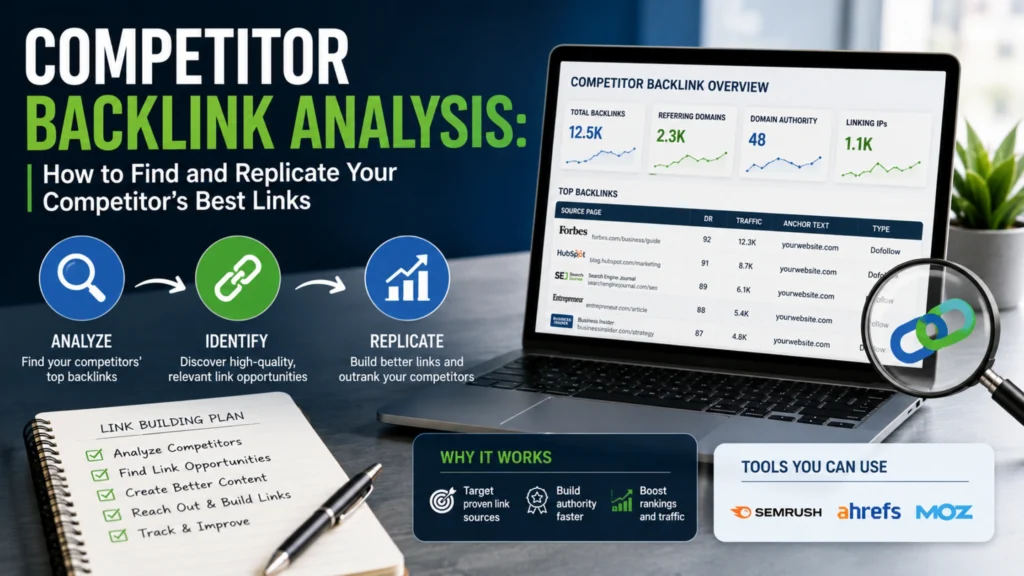
Competitor Backlink Analysis: How to Find and Replicate Your Competitor’s Best Links
Competitor backlink analysis is the process of studying where your competitors get their backlinks from…

CodeFyze
July 30, 2026
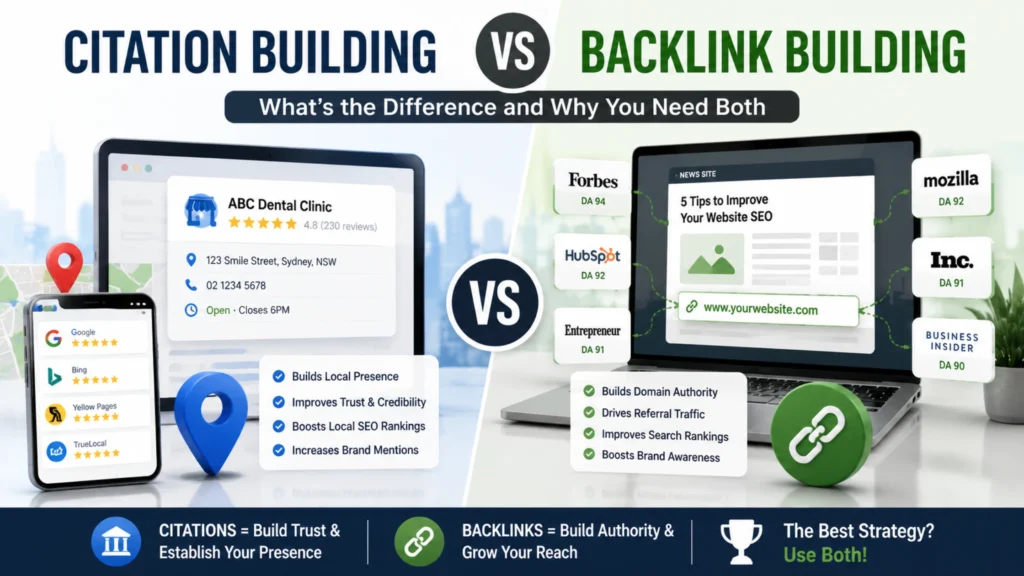
Citation Building vs Backlink Building: What’s the Difference and Why You Need Both
Citation building involves listing your business’s name, address, and phone number (NAP) consistently across online…
CodeFyze
July 29, 2026

HARO/Journalist Outreach: Getting Backlinks from News and Media Sites
HARO link building is the process of earning high-authority backlinks by responding to journalist queries…
CodeFyze
July 29, 2026
Questions? Reach us on Whatsapp +971 55 265 4401 Or Email info@codefyze.com
Questions? Reach us on Whatsapp +44 798 504 1813 Or Email info@codefyze.com
< recent blogs >
Latest Insights & Articles
Explore our latest articles, tips, and insights all in one place.
#BacklinkAnalysis, #CodeFyze, #CompetitorSEO, #DigitalMarketing, #LinkBuilding, #OffPageSEO, #SemrushSEO, #SEOStrategy, #SEOTools
Competitor Backlink Analysis: How to Find and Replicate Your Competitor’s Best Links
Competitor backlink analysis is the process of studying where your competitors get their backlinks from…
CodeFyze
July 30, 2026
#BacklinkBuilding, #CitationBuilding, #CodeFyze, #DigitalMarketing, #GoogleBusinessProfile, #LocalSEO, #NAPCitations, #SEOStrategy
Citation Building vs Backlink Building: What’s the Difference and Why You Need Both
Citation building involves listing your business’s name, address, and phone number (NAP) consistently across online…
CodeFyze
July 29, 2026
#BacklinkStrategy, #CodeFyze, #ContentMarketing, #DigitalPR, #EEAT, #HARO, #JournalistOutreach, #LinkBuilding
HARO/Journalist Outreach: Getting Backlinks from News and Media Sites
HARO link building is the process of earning high-authority backlinks by responding to journalist queries…
CodeFyze
July 29, 2026